Friday, October 15, 2010

Hiking north of Kristiansand.

My son Mark and I have done a bit of hiking in the park north of Kristiansand over the past month or so.  This park is a mixture of pine and deciduous forest (lots of white-barked birch trees), with some swamp mixed in.  There are quite a few lakes, although these to some extent are the result of man-made dams. 


Here is Mark--he's holding the map, which we consulted frequently.


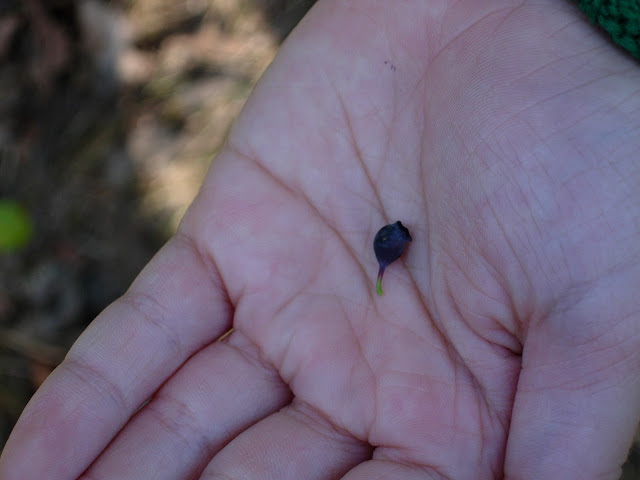
Mark identified this as a bilberry.


A big mushroom.
This is from a trail that we took up a hill.  Mark pointed out the grains of rock and suggested that they were the result of erosion.


Saturday, October 9, 2010

2010 Nobel Peace Prize Winner Announced.

A few days ago, the Nobel Peace Prize for 2010 was awarded to Chinese dissident and pro-democracy activist Liu Xiaobo.  Every year, the Nobel Committee, an organization headquartered in Oslo, Norway, gives the prize to someone whose life work has benefited humanity.  Here's a picture of Xiaobo:

Photo: Will Burgess/Reuters/SCANPIX from the Nobel Peace Prize website.

Last year, as a reward for his incessant advocacy of civil liberties and democracy, the Chinese government sentenced Xiaobo to eleven years in prison.  His crime was "inciting subversion of the state."  Xiaobo had helped author Charter 08, which had advocated that China adopt a democratic form of government.

The Peace Prize can trace its origins to the nineteenth-century Swedish industrialist Alfred Nobel (pictured below) who became immensely wealthy from devising and marketing high explosives--he invented dynamite.  Nobel died in 1896, and in his will he instructed that his fortune be used to award prizes in a variety of fields, including the promotion of peace.

Alfred Nobel, Copyright © The Nobel Foundation
Image from the Nobel Peace Prize website.

Past winners have been awarded not only for their efforts to foster peace between nations, but for efforts to stop government repression and end poverty.  Previous recipients include author Elie Wiesel, whose writings eloquently depict the barbarism of the Holocaust, Martin Luther King, Jr. for his leadership in the struggle against racial segregation, and in 1905 to Austrian peace activist Bertha von Suttner.   Suttner, one of the earliest recipients of the prize, is largely forgotten today, but she presciently forecast that future wars would be monstrous high-tech affairs. 

Much of the time, the prize goes to "agitators"--that is, writers or activists whose life goal is to highlight injustice.  This was presumably the Nobel Committee's thinking when it awarded the peace prize in 1975 to Russian physicist and dissident Andrei Sakharov, whose work on behalf of human rights challenged the Soviet Union's repressive policies.  Once in a while, the Committee awards the prize to powerful politicians who in its judgment have made important contributions to humankind--an example of this would be when the American President Theodore Roosevelt was given the prize in 1906 for his efforts to broker an end to the Russo-Japanese War. 

In any case, this year's award has really ticked off the Chinese government, which is making its displeasure known.  Bloomberg News reports:
The awarding of the Nobel Peace Prize to Liu violates the prize’s purpose and will hurt Norway’s relations with China, Ma Zhaoxu, a spokesman for the Chinese Ministry of Foreign Affairs, said in a statement on its website today....China summoned Norway’s ambassador Svein O. Saether to a meeting earlier today, Ragnhild Imerslund, a spokeswoman at the Oslo-based Foreign Ministry, said by phone. China’s Ambassador to Norway, Tang Guoqiang, also met with state secretary Erik Lahnstein, she said.
The New York Times:
As presidents, religious figures and rights advocates around the world praised the Nobel Committee and called on the Chinese government to release Mr. Liu, one of China’s most prominent dissidents, the Chinese government reacted with unrestrained ire.  They called in the Norwegian ambassador in Beijing for a dressing down, placed scores of dissidents under house arrest and angrily described the decision to honor Mr. Liu as “blasphemy” and an insult to the Chinese people.
Meanwhile, the Associated Press reports the following from China:
The world's newest Nobel Peace Prize winner remained unreachable in a Chinese prison Saturday, while his wife's mobile phone was cut off and the authoritarian government continued to censor reports about democracy campaigner Liu Xiaobo's honor.  Police kept reporters away from the prison where Liu is serving an 11-year sentence for subversion, and his lawyer said that Liu's wife — who had been hoping to visit him Saturday and tell him the news of the award — has "disappeared" and he is worried she may be in police custody.  Chinese authorities, who called Liu a criminal shortly after his award Friday and said his winning "desecrates the prize," sank Saturday into official silence.


Sources used in this post:
The official Nobel Committee website is here: http://nobelpeaceprize.org/
http://www.bloomberg.com/news/2010-10-08/nobel-peace-prize-for-dissident-liu-has-china-warning-norway-on-relations.html
http://www.nytimes.com/2010/10/10/world/asia/10china.html?hp
http://www.msnbc.msn.com/id/39588135/ns/world_news-asiapacific/  (AP news article)

Wednesday, September 1, 2010

Oil and transportation.


As of 2008, Norway was the world's 11th largest producer of oil, and since the Norwegian population is less than five million people, the vast majority of the oil drilled by Norway is exported, making Norway the world's fifth largest net oil exporter.  Norway gets its oil from offshore rigs, such as the one featured below, most of which are located in the North Sea. 
 
From: http://www.nytimes.com/2008/03/22/world/europe/22norway.html

The discovery of oil in North Sea in 1969 helped transform a country that was poor by western European standards into one of the wealthiest nations in the world.   A number of Norwegians we have talked to have noted that not long ago, their nation was much less prosperous than it is today.

Oddly enough, despite this surplus of oil, gasoline in Norway is much more expensive than in the United States.  

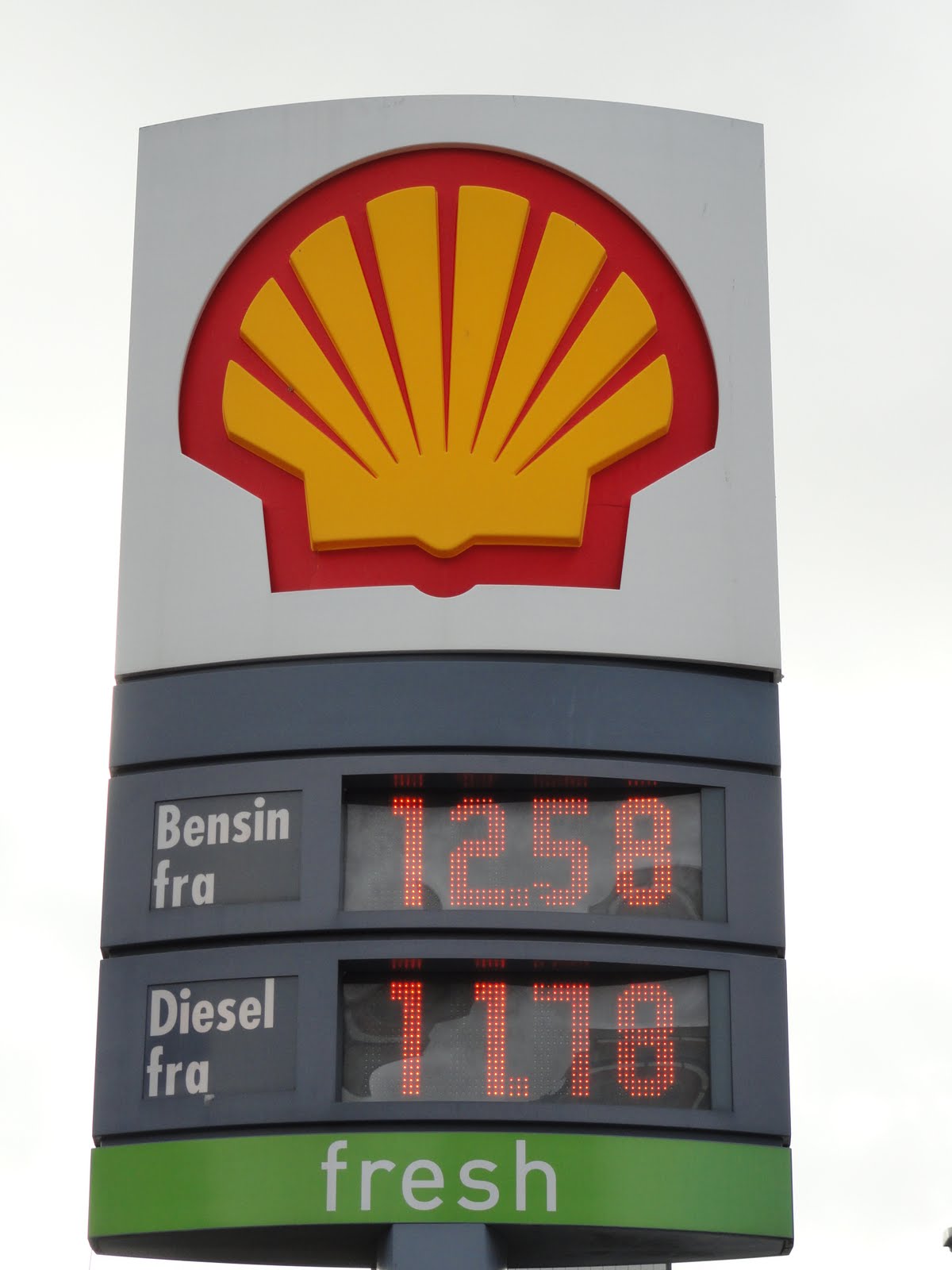
At the Kristiansand Shell station whose sign is featured here, bensin (i.e., gasoline) was 12.58 kroner per liter.  Given that there are about 3.79 liters in a gallon, and that the current exchange rate is about 6.3 kroner to the dollar, this means that a gallon of gas in Norway would cost more than $7.50!

This high gasoline price is due to high government taxes.  This decision to tax gasoline at a high rate has helped to shape Norwegian society in distinctive ways.

When gasoline is expensive, people are less likely to use it.   So, Norwegians in many cases simply ditch their cars and instead either walk or take a bus or train (which per passenger, use less gasoline per mile traveled than do cars).  The self-imposed high gasoline prices help explain why so many people walk or ride bicycles to get around here.   It's quite a common sight to see middle-aged or older people tooling around in Kristiansand on bicycles.

The presence of baskets or bags on so many bicycles around here testifies as to the utilitarian, rather than purely recreational, function of bicycling here.


(In some cases, you can get a larger version of the photograph by clicking on it.) 
In some parts of Kristiansand, the sidewalk is divided into pedestrian and bicycle lanes.  If you're a pedestrian, it's a good idea to stay out of the bike lane, as some bicyclists zip around pretty fast.


And while lots of people do have automobiles, it's much more common for people here to take buses to get around.   Likewise, when people travel from one city to another, they will very often use trains or buses instead of hopping in a car.   And while in U.S. cities the average bus rider is often lower-income, it's typical for middle-class Norwegians to take the bus.

Since fewer Norwegians use cars, many shoppers here place a premium on being able to get to their store easily by bus, bike or foot.  As a result, grocery-store chains set up lots of different postage-stamp sized stores throughout a city to cater to the people who don't have or otherwise don't use a car.  Here's some exterior and interior shots of one of these small grocery stores, which is located in a residential area not far from the University of Agder--


The blue and yellow signs on the side announce this to be a Coop Prix store, which is a grocery chain here.


In America, by contrast, grocery store chains set up stores that are much larger and farther apart--the additional distance doesn't bother Americans, since an extra few miles to the store only means a few more minutes driving.

The greater reliance on public transportation, walking, and bikes helps explain why the average Norwegian only uses about 1.9 gallons of gas per day, as compared to the average American, who uses about two and a half gallons per day and probably helps account for why Norway has a lower obesity rate (11% of the male adult population and 8% of the adult female population) than that of the United States (31.1% of the adult male population and 33.2% of the adult female population).

The Norwegian urban layout, with its relative dearth of cars, may seem like a completely alien way of doing things to Americans today, but it actually is very similar to the geography of American cities eighty years ago.  In the early twentieth century, relatively few Americans had cars, and residents of cities such as New York, Chicago, and St. Louis, got around by walking or by taking electric trolleys.   As celebrated in the 1944 film Meet Me in St. Louis, ("Clang Clang Clang Went the Trolley!") Americans in the first half of the twentieth century used trolleys a lot--St. Louis had hundreds of miles of trolley track as of 1900.  And to get from big city to big city, (say, Chicago to St. Louis) most people in the early twentieth century took steam trains.  And to get from cities that were close to one another, one could take what were called interurban trains--so one could go from St. Louis, for example, to Lebanon, Illinois, via interurbans.

Back to Norway.   In any case, the heavy gasoline taxes also help account for the fact that Norwegians generally drive smaller cars than do Americans.   Here are some parked cars I photographed around here:


There are lots of compact cars, small sedans, and station wagons, but relatively few sport utility vehicles or pickup trucks.  Tax policy again plays a role.  As the father of one of Walter's soccer mates explained to me a few days ago, the government imposes high taxes on heavy cars and on cars whose engines have a lot of horsepower, raising their purchase prices.  As a result, Norwegians are more reluctant to invest in big, heavy, vehicles.

At the same time, it's worth noting that a new shopping district located east of Kristiansand was clearly built to serve customers who arrive and depart by car.   Here are some photographs I took when I visited a few days ago--the layout here is similar to the shopping district that one might find off an American interstate--lots of "big-box" style stores with plenty of parking space. 

The ICA is a supermarket chain, whose store depicted above is a lot bigger that the Coop Prix shown earlier.


In any case, the North Sea oil bonanza will come to an end at some point, as Norwegian oil production from the North Sea either has peaked, is peaking, or will peak soon.  The following chart is from the U.S. Energy Information Administration, a federal agency that tracks oil production around the globe:

Chart from: http://www.eia.gov/countries/country-data.cfm?fips=NO#pet

Norwegians, aware that their oil will dry up at some point, have used the oil revenues to create a special national savings account, called the sovereign wealth fund, which is worth more than 400 billion U.S. dollars.  Basically, it's money designed to cushion the economic blow when the North Sea oil runs out. 


Notes on sources:
Information on energy production and consumption came from the U.S. Energy Information Administration website and from the CIA World Factbook (https://www.cia.gov/library/publications/the-world-factbook/)  The CIA Factbook is filled with valuable statistical information on countries around the world. 

Information on obesity rates came from the World Health Organization country-by-country downloadable guides: http://www.who.int/countries/en/


Sunday, August 22, 2010

Norwegian Geography.

Here's a map of Norway.  As you can see, Kristiansand (where we are staying) is in the south of Norway, so it has a relatively moderate climate compared to the rest of the country.  

About 4,800,000 people live in Norway, as opposed to almost six million inhabitants of the state of Missouri and more than 300,000,000 residents of the United States. 

In terms of surface area, the country is the 67th largest in the world--about 117,484 square miles, compared to Missouri, which is 69,704 square miles.  So the population density of Norway is much less than that of the “Show Me” state.   And while much of Missouri’s land is used for farming, much of the Norwegian terrain is very inhospitable to agriculture, with thin soil and bare rock.  When we’ve gone hiking around Kristiansand, for example, we've noticed that quite a bit of the ground is simply exposed rock dotted with moss and lichens—not the best kind of land for growing crops.  Indeed, only a small percentage of the land is farmed. Much of the soil that Norway used to have was scoured away by glaciers during the ice age.


One would think that Norway, given its northern latitude (Kristiansand, one of the southernmost cities in Norway, is about 58 degrees North, while Boston is 42 degrees North, and Ottawa, the capital of Canada, is about 45 degrees North) would be much colder than it is.  

Surprisingly, the coastal city of Bergen, Norway (you can see it on the above map), with a latitude of 60 degrees North, has milder winters than Minneapolis, which is about 44 degrees North.  In January, Bergen ranges between an average low of 30.2 degrees Fahrenheit (F) to an average high of 37.4 degrees F, while Minneapolis thermometers register between an average low of 6.8 degrees F and an average high of 21.2 degrees F!

What keeps Norway from turning into a gigantic icicle are ocean and wind currents.  It just so happens that there's a giant stream of water that originates in the gulf of Mexico and flows northeast along the eastern coast of the United States and Canada, and then travels east and north across the Atlantic, where it bumps up against the west coast of Europe.  This current that flows northeast along the eastern seaboard of the U.S. is known as the Gulf Stream; when the current reaches the eastern coast of Canada and begins to extend out into the Atlantic, it is then known as the North Atlantic Current.  So this combined Gulf Stream/North Atlantic Current is a giant conveyor belt transporting liquid heat from the warm and sunny waters off Florida to the western coast of Europe.

And, it also turns out that the wind currents at Norway’s latitude blow from west to east. So, what happens is this:

The sun warms the waters in the gulf of Mexico, which carry their heat energy north and west across the Atlantic up to the western coast of Europe, where the water heats the coastline and the air, and where the prevailing winds blow the warm air over Norway (and over much of Europe, for that matter) rescuing Norway (and much the continent of Europe) from what would otherwise be a much chillier winter.

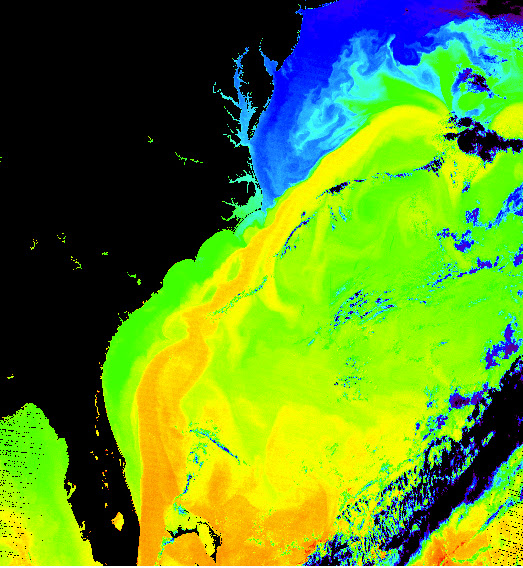
Below is an image of the Gulf Stream as it flows north and east along the Atlantic coast of North America.  This image comes from data collected from a NASA satellite, and is what you would call a false-color image--that is, the satellite used its sensors to map out oceanic temperatures, and then someone at NASA assigned colors to represent various water temperatures, with darker colors, such as blue, representing cool water temperatures, and with brighter colors, such as yellow and orange, indicating warm temperatures.  The big yellow and orange stripe is the Gulf Stream.
(From: http://visibleearth.nasa.gov/view_rec.php?id=5248).

Eventually, much of the warm water represented by that bright stripe will reach Norway. 

Nonetheless, despite the warming effect of the Gulf Stream/North Atlantic Current, Norway does get pretty cold in the winter, as the image below, taken by a NASA satellite in February of 2003, shows--and this one is a true-color image--
Scandinavian Peninsula in Winter
(From: http://earthobservatory.nasa.gov/IOTD/view.php?id=3239)


The deep cracks that you see in the western coastline in the above photograph are fjords.  Fjords are deep valleys, often with steep walls, that were gouged out of the earth by glaciers during the ice age.  Yep, the same glaciers that squeegeed off Norwegian dirt also left deep crevasses along the coast.  Courtesy of NASA again, here's a satellite closeup of a fjord--
aster_norway_artII_lrg.jpg (3600×3600)
(From: http://earthobservatory.nasa.gov/IOTD/view.php?id=4605)

Here's a closer view of a fjord--
Sognefjord,_Norway.jpg (700×473)
(From: http://en.wikipedia.org/wiki/File:Sognefjord,_Norway.jpg)


Friday, August 20, 2010

Norwegians and the Weather.

One of the things that we've learned here is that Norwegians have a different attitude to the weather than do Americans.

When we had an orientation visit with the principal of the school where our sons will be attending, he noted in passing that in his five years as headmaster, school had never been canceled due to weather.   Basically, students are expected to come to school in all save catastrophic meteorological conditions.

School started last week.  My sons Mark and Walter found that rain did not result in recess being held indoors, as would have been done back in O'Fallon, Illinois.  Students here, my sons reported, simply go out and play in the rain.

Likewise, Walter's hour of afterschool soccer practice was not canceled despite a light rain.  It helped that the field was covered with artificial turf--otherwise the field might have become muddy.

I think that Norwegians pride themselves on embracing the elements.

Sunday, August 8, 2010

First Post.

Hello everyone (and a special shout-out to everyone at Block Yeshiva High School in St. Louis, Missouri, USA)!  We've finally arrived in Norway!We took a plane from St. Louis to Chicago, and from there embarked on another plane that took us all the way to Stockholm, Sweden.  Then, got on another plane to Oslo, the capital of Norway, at which point we took a train, a bus, and then a train again to reach the city of Kristiansand, which is on the coast of southern Norway.  Looking outside of the train windows, we got some notion of what the terrain looked like.  Unlike the American midwest, where the landscape outside of the cities and suburbs is overwhelmingly agricultural, with lots of fields filled with corn and soybean plants, in Norway the land (or at least the part of it that we've seen from the train) is much less hospitable to farming--there's lots of exposed rock and plenty of pine trees.  For the last leg of our train trip (normally, it would have simply been one trip, but there was a detour due to construction, so we had to take one short train trip, then a short bus trip around the construction, then a longer train trip), we arranged to ride on the railroad car designed for children--it had fewer seats and more open space so that children could walk around.  What was also nice is that riding in the children's car did not cost any more money.

The weather here is cooler than in St. Louis--tomorrow's high in Kristiansand is supposed to be around 70 degrees Fahrenheit.  That it's colder here is not so surprising--given that the latitude here is about 58 degrees north on the map, as opposed to St. Louis, whose latitude is a little more than 38 degrees north on the map.  What are lines of latitude?  They are imaginary horizontal lines circling the globe going east-west.  The further north you are in the northern hemisphere, the higher the latitude, with the latitude at the equator being 0 degrees, and the latitude at the north pole being 90 degrees north.Because we are so far north, the days in the summertime are longer than in St. Louis.  Sunrise today was at about 5:35, while sunset will come at 9:31.  By comparison, sunrise in St. Louis arrived at 6:09 this morning, and sunset will fall at 8:04 pm.  This will change pretty quickly, until during the winter the days will be shorter than they are in St. Louis.  Many people here speak English--they really push the learning of English in the grade schools--so we haven't had to use the phrasebook that we brought along.  That's all for now--more later.